The Nudge Happens Whether or Not You Remember to Send It
Automated follow-up can turn group-chat enthusiasm into real plans.
An AI assistant that follows up on plans so you do not have to must do more than send reminders. It must move the conversation toward a confirmed time while leaving judgment and consent with the people involved. The nudge happens whether or not anyone remembers to send it, closing the gap between wanting to meet and putting a plan on the calendar.
Why plans die in the thread
The thread has gone quiet, but the invitation still stands. Everyone seemed happy at the thought of getting together. There was agreement that it had been too long, followed by a few suggestions and then silence. Nothing in that sequence necessarily signals a loss of interest. The moment of maximum enthusiasm is disconnected from the later moment when someone needs to confirm the plan.
Unlike a work meeting or a medical appointment, an informal gathering has no authority enforcing it, no financial penalty for canceling, and no system tracking whether it happened. It rests on social goodwill, which can be sincere and still be deferred. Asynchronous messaging makes that deferral easy because a conversation about finding a time can continue indefinitely without producing a date. No single delay looks like the decisive failure.
Each person postpones a small task, such as checking a calendar or answering a suggestion. Yet those individually reasonable delays can become the reason a close friend has not been seen in months. The coordination gap is structural. Interest starts the conversation, but it does not supply the mechanism that finishes it.
Why group chats are especially bad at converting interest into plans
The last message was three days ago. Several people expressed enthusiasm, but nobody settled the weekend, and restarting the thread now feels like a separate task. Group chats make this situation particularly easy to reach because they are built for conversation. A response can acknowledge an invitation without advancing it. Expressed enthusiasm is not a commitment until someone confirms a date, answers a poll, or takes another specific action.
This is the Volunteer's Dilemma in an everyday setting. Everyone wants to get together, but looking for places to meet, finding out who is free, and chasing replies are less appealing than showing up. As the group grows, so does the expectation that someone else will handle those tasks. Diffusion of responsibility leaves more potential coordinators without necessarily producing an actual one. Even a busy thread can hide a gap in who takes charge.
Decision fatigue makes that gap harder to close. When someone is asked which weekend works, they may already have little energy left to make another choice. Asking about the date, venue, and logistics together adds several unresolved decisions to the same conversation. Instead of answering, the recipient leaves the message for later. Meanwhile, other replies can address different parts of the question without resolving any of them.
The window closes without a formal decision. Two weeks of postponement can pass while the group still treats the invitation as a live possibility. Nobody has canceled, so nobody has to explain why the gathering is not happening. But someone must now restart the talk about plans and get people engaged in it again. That is a heavier task than answering the original invitation.
The asymmetry of the follow-up: why the nudge falls on the wrong person
The person who takes on that task is usually the one who cares most. Wanting to preserve the relationship supplies a reason to act, but it does not supply spare energy. The same person may send the date poll, follow up on unanswered questions, and make the final call. Each step requires effort without guaranteeing a result.
Timing adds another layer of work. A nudge sent too soon can feel pushy, while one sent too late leaves the person in charge trying to restart a quiet thread. Behavioral economists call the mismatch between optimistic intentions and a later, depleted state the hot-cold empathy gap. Agreeing to handle the arrangements is easier than sustaining that promise when tired on a Wednesday night.
Over time, the imbalance can change the relationship’s tone. The person who repeatedly follows up starts to feel like the pursuer, while the recipient can feel vaguely obligated. People can feel either way and still care about each other. It shows how coordination work can become entangled with the meaning people assign to contact. A missing reply starts to matter more to people's feelings than deciding when to meet.
Conventionally, someone is expected to step up. That leaves the same dependency intact, because the plan still relies on one person having enough willingness and energy at the right moment. A follow-up assigned to a person remains vulnerable to that person’s exhaustion. Assigning its timing to a system removes that particular source of fragility.
What an AI assistant that follows up on plans should actually do
Automated follow-through means handling the timing, follow-up cadence, and push toward confirmation that memory and energy often fail to sustain. A message can stick to making plans without pretending to offer the warmth of a personal exchange. The people involved still decide whether and how they want to meet.
The DoubleAgents study at HCOMP 2026 looked at human-agent alignment in tasks where people coordinate with others in a social setting. The study framed the goal as letting people offload work while maintaining control. Participants became more comfortable delegating as the system demonstrated alignment with their preferences. The finding is limited to the social coordination tasks studied. The research also found a continuing need for control around uncertainty, edge cases, and context-dependent actions.
Routine cadence can be automated, while ambiguous decisions remain subject to human judgment. A reminder without action is an alarm with a nicer icon. If it merely tells the organizer to chase everyone again, the coordination burden has not moved very far. Follow-through instead advances the plan by proposing a time, surfacing availability, or sending the confirmation.
The delivery channel is part of that definition. A useful nudge arrives in the conversation where the plan is forming, with the information needed to answer it. Keeping the discussion in place also distinguishes scheduling follow-through from a general promise to send messages after meetings. Automating a message is narrower than resolving the practical uncertainty that made the follow-up necessary.
Where in-chat scheduling closes the gap that standalone tools leave open
Standalone scheduling tools can help people book appointments while still leaving them to work out plans from a loose group invitation. Reclaim and Cal.com are largely optimized for professional scheduling as of 2026. Their fit differs from the softer task of converting interest in a chat into a shared commitment.
Someone must leave the thread, navigate to another tool, and return with a link before the group can continue. Each step asks for more effort from the person already doing the coordinating. The friction is small but poorly placed. It appears precisely between the expression of interest and the action needed to make that interest concrete.
Google Workspace with Gemini added a feature in November 2026 that detects scheduling intent in Google Chat conversations and converts it into a confirmed calendar event in one click. People making social plans need the same help in a different setting, and iMessage and SMS are familiar channels they already have installed, where they can make plans without moving to a separate planning tool.
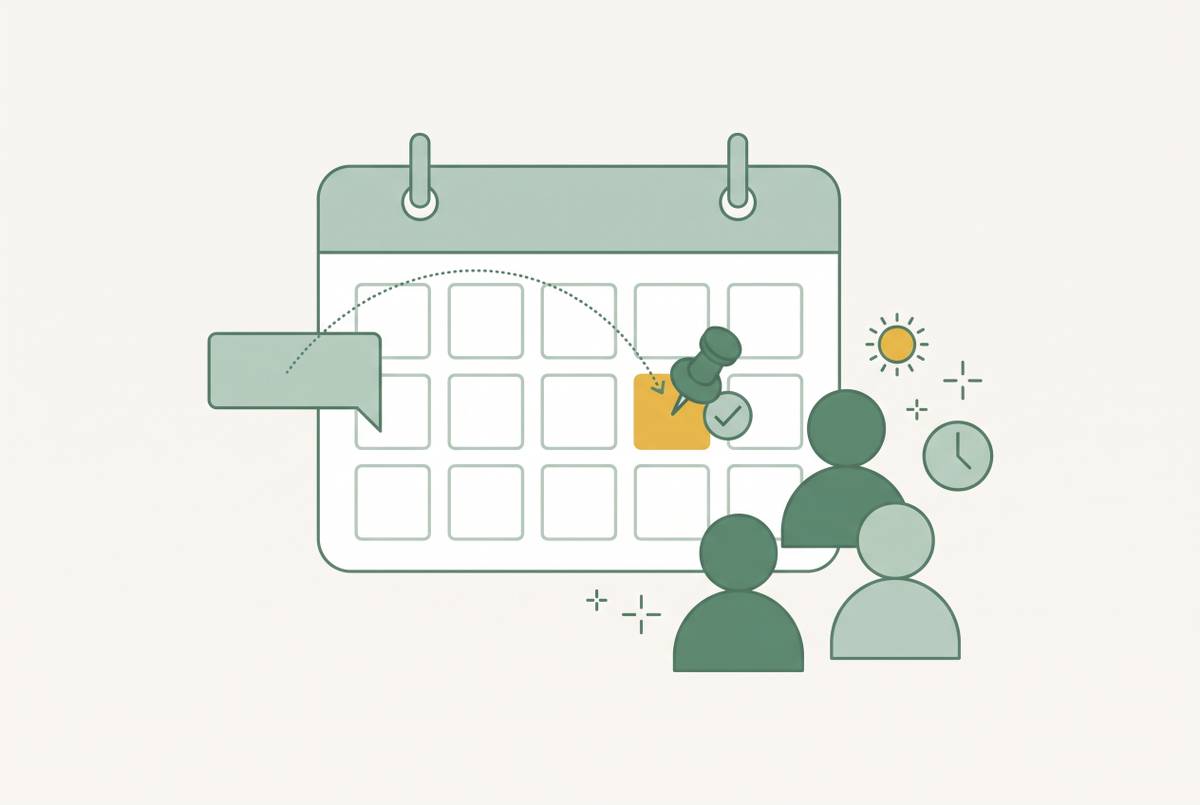
An in-chat assistant can close the gap by surfacing availability, proposing a time, and sending the calendar invite without moving participants out of the conversation. The mechanism compresses intention and action into a few messages. Spontaneous plans avoid much of this gap because agreement and action occur together. In-chat coordination brings agreement and action closer together for plans that still need to be scheduled ahead of time.
The privacy question: what an AI in your group chat should and shouldn't know
Adding an assistant to that conversation gives people reason to worry about privacy. A group thread can expose relationships, conversation history, and interpersonal dynamics as well as availability. These are not interchangeable categories of data. Inferring emotional vulnerability or social closeness from message patterns creates a different kind of exposure from identifying a suitable meeting time.
AI assistants in 2026 read emails, summarize meetings, and organize files. Putting those sources together can reveal sensitive information that a person never chose to share. Privacy concerns therefore extend beyond an assistant’s permission to view a calendar to what it is permitted to infer and act on across the information available to it. Convenience alone does not answer that concern.
A concrete boundary limits what participants see to availability, keeping event details private. The group needs to know whether a suggested time works, which may not require knowing what fills every slot that clashes with it. That separation limits what scheduling exposes to other participants. It is more useful than an abstract assurance of privacy. It does not, however, establish an absolute guarantee about every other aspect of a tool’s data handling.
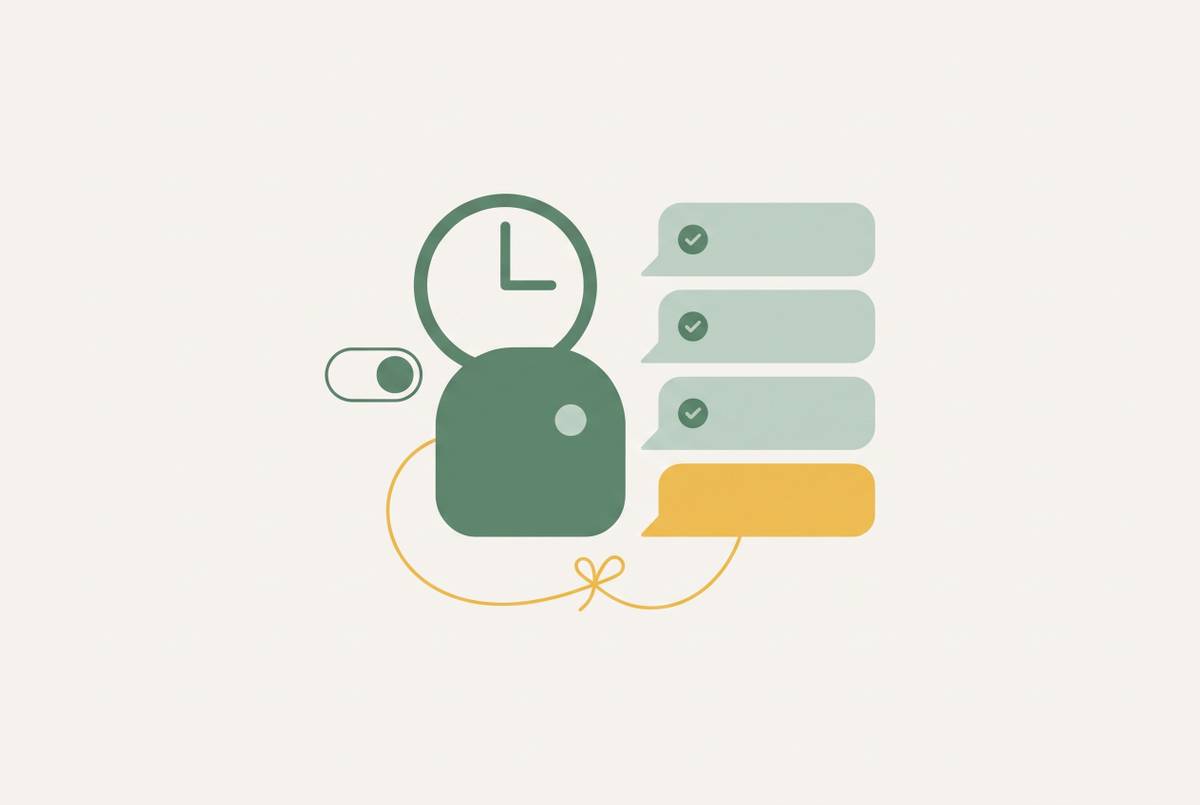
Control over action is equally important. The DoubleAgents findings support letting people step in when context or uncertainty changes what a decision means. Gentle follow-ups that can be turned off in settings follow the same design logic. People retain a way to stop the automated cadence rather than accept it as an unavoidable condition of participation.
What actually happens when the nudge is no longer anyone's job
The immediate change is that an unanswered scheduling question need not become another task for the most invested friend. The follow-up can go ahead without waiting for that person to notice the silence, find the energy, and decide whether another message will feel like too much. The relationship is less dependent on one evening’s energy. What used to be one person's duty becomes a routine part of getting the plan settled.
Authenticity remains a real concern. Friends and family can experience an AI-assisted message as less warm once they know how it was produced. A scheduling follow-up creates the conditions for time together.
Recurring plans can reduce the burden further. A standing commitment replaces repeated decisions about whether and when to meet with a single agreed pattern. An in-chat assistant can support that pattern without requiring someone to restart the arrangements each time. Memory of a food restriction, a workable neighborhood, or a usually free day can also save participants from repeating themselves. Such memory serves the relationship when it supports their preferences rather than claiming to understand the relationship itself.
The assistant’s work has a natural endpoint. It sends the nudge, helps confirm the time, delivers the invite, and then goes quiet. Nobody needs to keep pursuing the group once the uncertainty has been resolved. The conversation that follows belongs to the people attending. The plan is on the calendar, and Thursday dinner is happening.