Assumptive Scheduling as a Technique for Making Plans Stick
Proposing a specific time turns group-chat enthusiasm into plans.
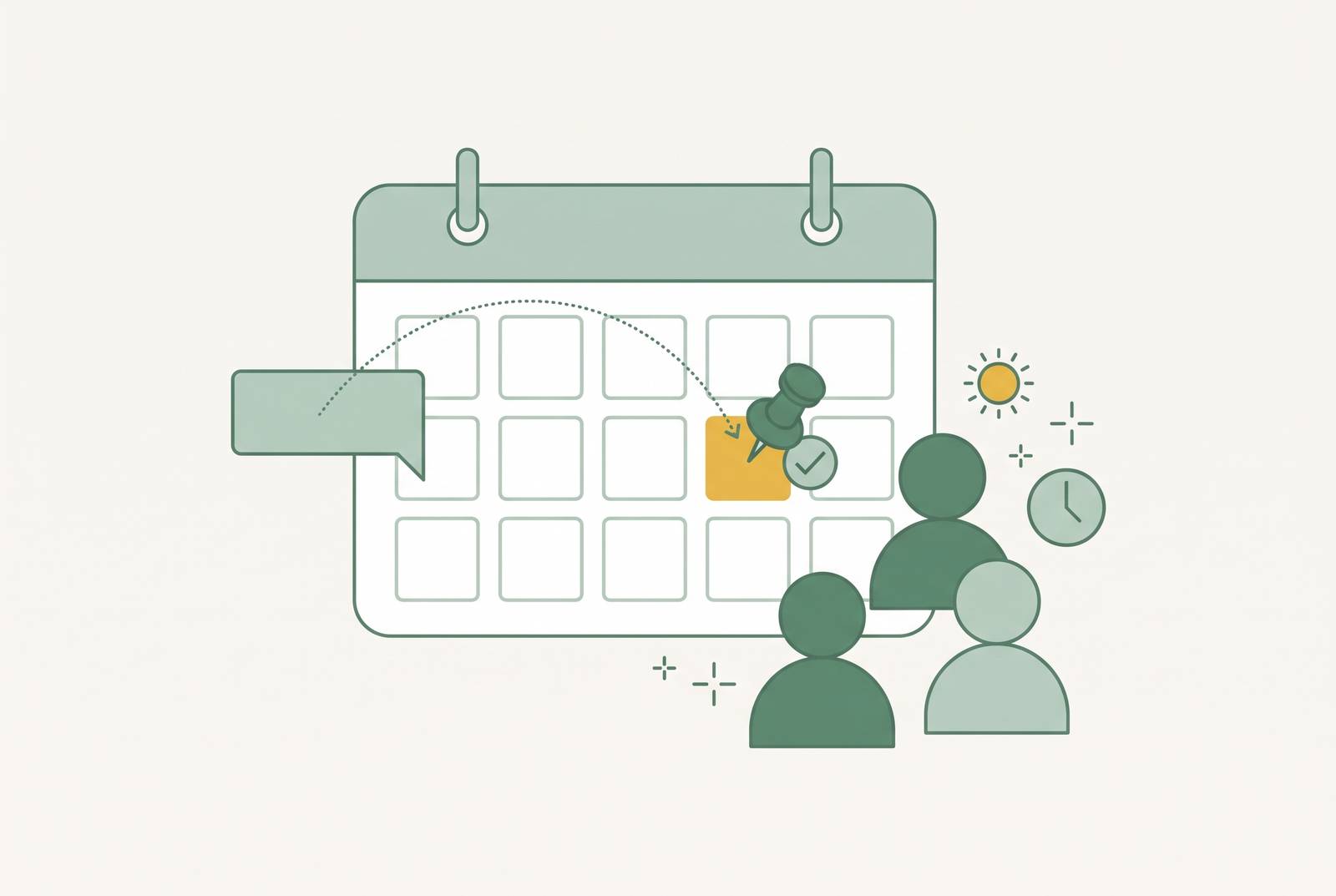
Assumptive scheduling fixes plans that die in the group chat by replacing vague interest with a specific proposal that people can confirm or correct. Naming a time while enthusiasm is high makes following through easier than reopening the whole decision. The technique works when people already want to meet and can easily say no.
Propose a specific time and place yourself, and ask the group to confirm or correct it. "Saturday the 15th at 7 at the usual place, anyone have a conflict?" gives everyone one concrete plan to check against their calendar, where "when is everyone free?" hands the whole group an open-ended task that nobody picks up. Send it while enthusiasm is high and the thread is active, and follow up when people are likely to have bandwidth, such as Friday evening before a Saturday plan. It stays low-pressure because the message leaves room for a different time or a plain no, and because it works best when people already want to meet.
Why plans die in the thread: the structural failure of vague enthusiasm
The group thread has five enthusiastic replies and zero dates proposed. Everyone has endorsed the idea of meeting, but nobody has turned that interest into a commitment. The distinction is easy to miss in conversation. Saying “yes, let’s!” expresses warmth without settling when, where, or who will move the plan forward. Once the conversation ends, that unresolved work remains, with no clear owner.
With more than two people involved, coordination cost increases as aligning schedules takes more cognitive and logistical effort. Loose plans are particularly fragile because they leave a long interval in which enthusiasm can give way to competing obligations. Spontaneous plans have little time to accumulate that resistance, while a distant catch-up can gradually feel like another duty. When this keeps happening in a friendship, it leads to scheduling entropy, the slow loss of contact through dates that never get settled.
What assumptive scheduling is and where the technique comes from
“Saturday at 2” supplies a time to accept or correct, replacing the vague invitation “we should hang out sometime”. Assumptive scheduling means suggesting that next step and moving ahead as though the wish to meet will become a plan, while leaving room for people to object. It borrows its logic from the sales technique called the assumptive close, which moves from whether someone will proceed to how the next step will happen. With social plans, it is fair to start this way when people already want to meet.
The psychological mechanism is cognitive consistency. Robert Cialdini’s research on the Consistency Principle describes the personal and interpersonal pressure people face to act consistently once they have made a commitment or taken a stand. Interest alone is not the same trigger. A specific proposal gives that interest a chance to become a commitment rather than treating an enthusiastic reply as a binding agreement. The recipient can then respond to one plan.
That change reduces the work needed to answer. The default moves from “decide” to “confirm or correct,” so following through becomes the easier continuation of the exchange. Opting out requires a deliberate response rather than simply allowing an unfinished discussion to disappear. This is also the technique’s ethical boundary. Making it easier to agree is useful, but the method can work without making it awkward to say no.
Why the empathy gap makes someone else’s confident proposal so effective
A confident proposal is effective partly because people are poor forecasters of their future state. The person who welcomes Thursday coffee may underestimate how tired or overwhelmed they will feel on Wednesday night. This is the empathy gap at work. Naming a time while people are keen gives their original wish to meet a concrete form in the calendar before they feel less hopeful about it.
The obvious objection is that people can still cancel. Detkova and Stoyan’s 2025 SSRN paper explores whether some commitment failures are planned, with people anticipating future uncertainty and allowing for the possibility that backing out will become preferable. A broken commitment does not always mean it was pointless to make it, or that the person never wanted to come. It can reflect uncertainty that was present from the beginning.
Assumptive scheduling changes the status of the choice without eliminating that uncertainty. Canceling an existing plan requires a more deliberate act than never confirming an unfinished one. The distinction is small but practically useful. For the initiator, the named time also creates a timestamped record of the intention and a natural reason to return to the conversation. A later message can concern the proposed meeting rather than having to establish the wish to meet all over again.
How do I get a friend group to stop flaking and lock in a date without being pushy?
“When is everyone free?” looks considerate, but it distributes an open-ended task across the entire group. Each person must consider their availability, decide how much to report, and wait for someone to reconcile the replies. The thread has plenty of approval and no appointment. This is a collective action problem in the familiar form of friends being agreeable on their phones.
A specific proposal gives everyone the same plan to weigh up, so they can stop waiting for someone else to put one together. “Saturday the 15th at 7” is a different kind of question from “sometime next weekend” because it can be checked against an actual calendar. Adding the usual place removes another unsettled choice. The organizer has done the initial synthesis rather than asking the group to perform it collectively. Other participants can now confirm or identify a conflict without first solving everyone else’s schedule.
Most plans are negotiated on phones, with the text thread serving as the scheduling surface. The conversation can therefore move forward with a change to the message while staying in the same thread. A confident proposal helps people make plans in the thread while keeping the chat casual. The group can still disagree with the proposed plan.
The follow-up problem, and why assumptive scheduling is a structural fix rather than a motivational one
An unanswered proposal creates a socially uncomfortable choice for the person who sent it. Another message might rescue the plan, but it can also feel like an exposed request for attention, especially when the same person always initiates. A norm of reciprocity can suppress exactly the follow-up that would keep the connection alive.
Assumptive scheduling reduces this burden by including the next step in the original exchange. Naming a time while the conversation is active skips the later need to reopen contact with “just checking in.” The proposed meeting supplies a reason to return. If follow-up is also built into the structure, the initiator does not have to make a fresh decision about whether to chase the thread. Recurrence removes some of the social cost of re-initiation.
Proposal and confirmation are still separated by an interval. A nudge sent when the recipient has room to answer can do more useful work than a carefully persuasive message delivered into a busy afternoon. Timing becomes part of the mechanism. A reliable way to follow up takes care of when the message arrives and whether it gets sent, sparing one friend the awkwardness of having to take charge again and again.
What good assumptive scheduling looks like in practice: phrasing, timing, and the right level of specificity
The proposal should be specific enough to act on and open enough to correct. A usable message is “Saturday the 15th at 7 at the usual place — anyone have a conflict?” It contains a time, a place, and a correction window. By contrast, “we should hang out sometime” leaves every logistical choice unresolved.
“Does that work for you?” invites a direct answer about a concrete proposal, while “Does everyone agree to this?” can turn the exchange into a more formal demand for group assent. Small wording choices change the social burden. The correction window should make a different time or a refusal feel like an ordinary response. Specificity supplies momentum, while the invitation to correct preserves agency.
The best moment for the first proposal is when enthusiasm is high and the thread is active, rather than two days after the conversation has moved on. A follow-up serves a different purpose. It is better placed when the recipient is likely to have bandwidth, such as Friday evening before a Saturday plan.
Scheduling tools can help messages arrive at those times, though people still have to judge how they will be received. The iOS Shortcuts app provides a workaround for recurring SMS messages to contacts on non-Apple devices, while one-off scheduled SMS still requires a third-party app. That distinction affects which follow-up patterns the infrastructure supports. Whether a nudge is welcome or the proposed time is sensible still depends on how well the people know each other and what they have been saying.
The main objection: when assuming forward feels like pressure rather than a gift
Assuming yes transfers the burden of saying no to the recipient. For someone who finds declining difficult, a confident proposal can feel less like help and more like an obligation they must actively escape. The concern arises from the technique’s reliance on making inaction less attractive, a mechanism that can become uncomfortable when refusal already has a social cost.
Warm relationships provide a different setting from cold or asymmetric ones. Where mutual interest is established, a suggested time can read as a welcome contribution to shared logistics. Without that foundation, it may read as presumption. Confident phrasing needs calibration to the relationship. Assumptive scheduling is a way to implement an existing wish to meet.
Calibration also applies to follow-up and to the information used to make a proposal. A gentle check-in that is easy to redirect preserves more social grace than a demand for an answer. Pencil shares when people are free and keeps private event details out of the exchange, so the group can check whether a time works without asking why someone is busy. A gap in a calendar is useful coordination information, but the events around it need not become part of the group’s conversation.
Where an in-chat assistant fits: what it does that a determined human could not do as consistently
To keep making plans, someone has to remember, get the timing right, and keep following up, all at once. It gets harder to remember when people tend to be free, past plans, and what they have said they prefer across the moderate-strength connections most likely to drift. The personal CRM category reflects this effort. Yet keeping a record of each exchange can feel like sales work rather than friendship, adding another task between wanting to meet and asking. Knowing the technique does not remove that friction.
An in-chat assistant such as Pencil fits at this junction because the plan is already taking shape in conversation. The useful role is to keep the proposal, follow-up, and invitation in the thread rather than sending people to a booking page, separate app, or exported calendar link. This removes a context switch at a fragile moment. A determined person can do the underlying coordination, but maintaining the same timing and persistence across conversations is demanding. The assistant’s contribution is continuity.
That continuity needs limits that still hold when access changes. Instinct continued using retained email data after Claire Vo disconnected it from Google, a distinction from live access surviving revocation. The example establishes a concrete privacy standard. Access controls alone do not answer what happens to information already retained, and friends being scheduled with may never have opted into the system. Availability sharing narrows what needs to be exposed for the plan to proceed.
The same restraint should govern persistence. Gentle, well-timed follow-ups that can be turned off in settings support the relationship without turning the organizer’s intention into an unending demand. Once the plan reaches the calendar, the assistant has done its job. The desired outcome is not a conversation organized around a tool, but friends meeting at the time they finally settled. The memorable part should be the time spent together.