Two Weeks Dead in the Chat Is Not a Failed Plan It Is an Unforced Decision
Group chat plans fade through silence, and a nudge can help.
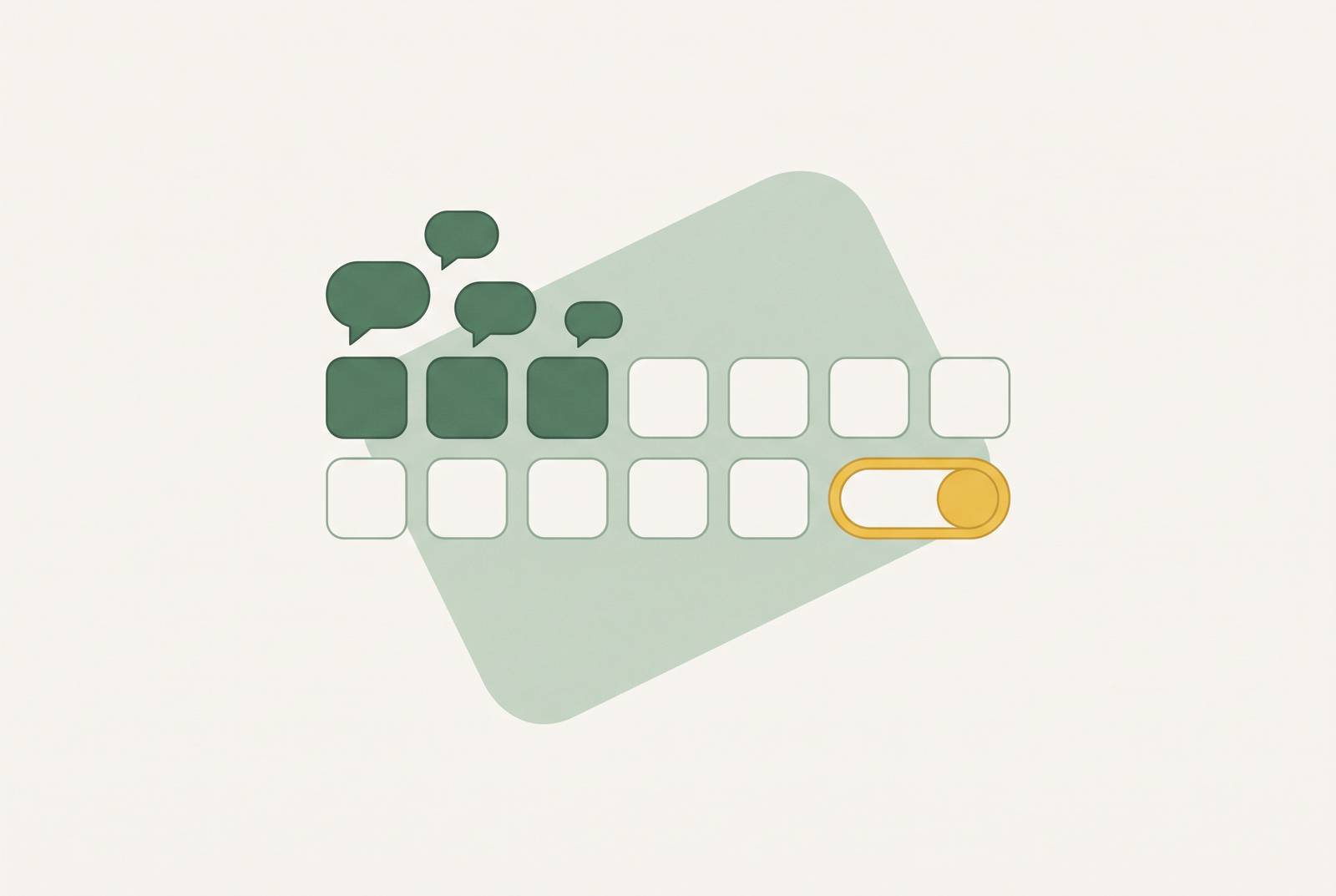
Fixing plans that die in the group chat requires turning enthusiasm into a specific decision before silence becomes the default answer. A thread left untouched for two weeks reflects repeated choices not to revive it. A discreet in-chat assistant can lower the effort of asking and responding, but people still have to choose to follow through.
Why group chats structurally suppress plans, not just delay them
The thread starts with a good suggestion, quick replies, and enough excitement to make it feel as though the gathering is almost set. Then the chat moves on before anyone sets a date. The apparent agreement has no durable form. A chat thread is designed for conversation. What looked like progress was often only activity.
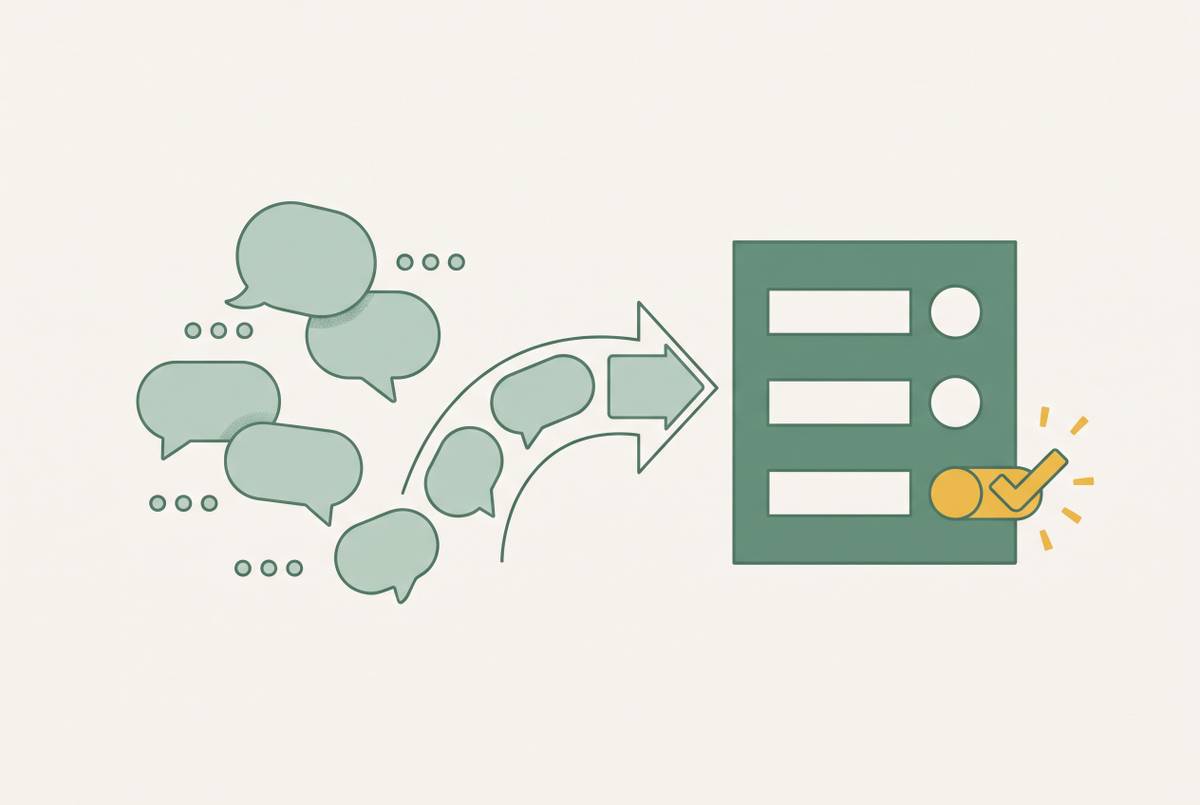
The structural gap is between expression and commitment. A fire emoji or thumbs-up can feel like an RSVP without establishing whether someone will attend a particular event at a particular time. The thread contains messages, but not a maintained account of the plan, a deadline, or a visible headcount. Someone trying to move it forward must reconstruct who agreed, who is wavering, and who has not answered. Without that work, nobody has a reliable view of what remains undecided.
Each new try at getting everyone to agree means digging up what the chat has already buried.
How diffusion of responsibility turns a leaderless thread into a daily non-decision
In a thread without a designated owner, each participant can reasonably expect someone else to take the next step. That expectation becomes the mechanism of collective inaction. Social psychology’s “volunteer's dilemma” describes the underlying conflict, in which everyone wants an outcome but nobody wants to absorb the cost of producing it. As the group grows, the expectation that another person will volunteer becomes easier to sustain.
Meanwhile, the work itself becomes more demanding. Pairwise coordination requirements grow quadratically with group size, because each new person adds more schedules, preferences, and logistics to work out with the others. Decision fatigue adds another obstacle. An open-ended question about which weekend works asks someone to weigh the choices after they have already made many decisions that day. The message can be read, mentally deferred, and forgotten without any loss of affection for the group.
Silence therefore has an outcome even without explicit agreement. Two weeks of it can aggregate small daily choices not to reopen the question into a de facto decision not to proceed. Some participants may genuinely prefer to skip the gathering, and some abandoned plans deserve to lapse. The distinction is between declining a plan and allowing inaction to decide its fate without acknowledging that a choice has been made.
Why the organizer's position is structurally uncomfortable, not just thankless
The person who might interrupt that pattern faces a double bind. Choosing a date unilaterally risks appearing controlling, while waiting for consensus leaves the plan exposed to indefinite drift. The organizer must take responsibility for an outcome without necessarily having permission to decide what it should look like.
The practical burden is also unevenly distributed. One person researches options, composes polls, and chases responses while others can remain silent until something is booked, then raise objections. That asymmetry makes organizing more than a collection of small administrative tasks. It requires sustained attention to preferences that other participants have not yet made explicit. The resulting resentment can make the same person less willing to volunteer next time.
Under these conditions, hesitation is rational. Waiting can look like respect for everyone else’s preferences even as it allows the plan to disappear. The organizer is trying to preserve both the gathering and the group’s sense of equality. A nudge from outside the group could ease that conflict by making it easier to take part without leaving one friend in charge of everyone else for good.
What the illusion of connection in an active thread costs a friendship over time
The rest of the chat may stay busy while a plan stalls. Unread messages make people feel that things are happening and that they belong, so the friendship feels cared for even when no one is planning time together. That feeling is not entirely false. Text contact is contact, and friendships need repeated contact of some kind to remain close. But messages do not provide the shared laughter, physical proximity, and eye contact available when people meet.
A group risks mistaking one form of connection for the whole relationship. A group can keep exchanging messages while repeatedly losing the opportunities that would give its members new experiences together. The chat preserves familiarity without necessarily preserving the same closeness. Each abandoned plan then becomes more than unfinished administration, because the shared time it promised never accumulates.
This gives the idea of a “friendship recession” a practical dimension without turning every quiet thread into a crisis. Affection can remain intact while coordination repeatedly fails. That is a different problem from people deciding that a friendship has ended, and it leaves room for intervention. The objective is not to manufacture more chat activity, but to help existing interest become time spent together.
How AI facilitation in group settings changes participation without changing the group's decision
Alsobay et al. at Microsoft Research ran a pre-registered experiment in 2026 with 1,475 participants in live groups and found that people shared more information with an LLM facilitator. The gain came from raising the minimum level of engagement, with quieter participants contributing more. However, the study found no significant effect of either human or AI facilitation on the final decision outcome. More participation did not produce a demonstrably better decision.
That distinction limits what the evidence supports about scheduling. The experiment concerned group decision-making, leaving open whether an assistant will turn an inactive thread into a confirmed gathering. It does support a narrower possibility. Facilitation can draw out contributions that a group otherwise fails to obtain, while leaving the harder problem of using those contributions unresolved.
For a stalled plan, a response about availability can be useful without being sufficient. A nudge may interrupt diffusion of responsibility, but it cannot supply a participant’s motivation to attend or follow through. The design implication is an early, low-stakes intervention that raises participation while leaving the decision with the group.
How the AI is embedded in the group shapes whether it helps or intrudes
In research presented at CHI 2026, Johnson et al. at the University of Michigan studied three modes of AI presence with 18 dyads who took part in realistic discussions with a GenAI agent. In Roundtable mode, the agent was always present and could speak at any time. Peripheral mode placed it outside the table, requiring an invitation to contribute. Breakout mode kept it outside the shared space but let people use it in private. Each setup gave people a different amount of control over when and how it took part.
The study found that this control shaped communication patterns and how participants negotiated the agent’s influence. Its presence was not socially neutral. Participants described discomfort when they ignored a prominently placed agent, showing how a visible tool can acquire social weight within a conversation. An assistant can therefore add another relationship to manage.
For social scheduling, the distinction is between available help and imposed management. An agent that speaks uninvited can change a casual exchange into something that feels supervised. Peripheral and Breakout modes offer a useful design parallel for an assistant that contributes when wanted and recedes when unnecessary. They establish why control over participation belongs in the design.
How can an in-chat assistant turn a group full of maybes into a confirmed hangout?
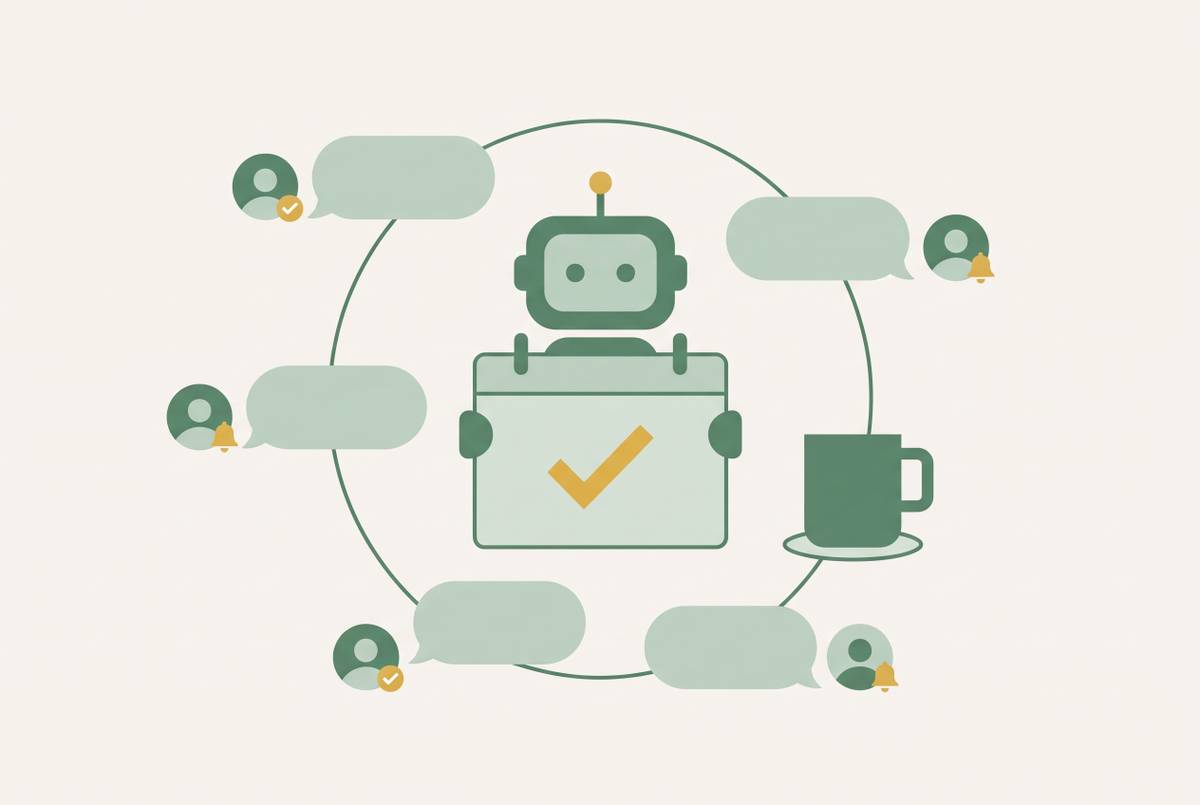
A well-designed in-chat assistant helps the group preserve a decision during the interval between expressed enthusiasm and a fixed date. Professional scheduling tools built around booking links help at a different stage of making a plan. They wait for someone to use the link, and when that person goes quiet, the responsibility for following up remains with the user.
Scheduling in the chat keeps it where people have already shown interest. The group does not first have to move into a separate app to begin resolving the plan. That removes a context switch at the moment when commitment is still fragile. A request at the right time for the details needed to move ahead helps more than another broad call to talk through what people might do.
Availability sharing also narrows the task appropriately. Participants need to know when someone is free while keeping private the event details that explain the rest of their calendar. Keeping those details separate lets people settle the plan without having to share their whole calendar to join in.
The privacy question an in-chat assistant must answer before the group trusts it
An assistant with useful relationship memory raises a consent problem that convenience alone cannot answer. The person whose details come up in a chat may never have chosen the assistant that gets them. Access to a user’s messages and contacts can expose details about friends and relatives, including privately shared schedules and preferences. Those people may not realize that their information has become available to an AI.
The richer an assistant’s understanding of relationships, the more it may depend on information drawn from other people’s communications. Sharing availability rather than event details reduces what the group needs to see, but it does not resolve every question about what the assistant holds. Disclosure to participants and retention by a tool are distinct concerns.
Editable preferences provide a concrete form of user control. They make at least that part of the assistant’s memory inspectable and changeable. This does not amount to consent from everyone mentioned in a message, and it should not be presented as such. Accepting less capability in some dimensions can be the appropriate trade when discretion is necessary for the group to trust the assistant at all.
What breaks the two-week silence, and what it feels like when the plan actually lands
“Saturday at 7, the place near yours” gives participants something specific to accept or decline. By contrast, “what works for you?” asks each person to help construct the plan before they can answer it. A specific plan makes it easier to reply, even though some people may disagree. A refusal is still useful because it makes the state of the plan clearer than silence does.
Small, repeatable plans can reduce the organizing burden further. A standing dinner, a monthly call, or a recurring coffee does not require the group to invent a fresh occasion every time. The two-week mark is useful as a signal. When nobody has acted for that long, recognizing the default decision creates an opportunity to make a deliberate one instead.
Once the date is settled, the assistant’s role should recede. The confirmation is sent, the invite exists, and the conversation can return to being a conversation between friends. The payoff arrives beyond the calendar entry, in shared laughter and time that no longer has to be imagined. A plan that might have faded away becomes an ordinary evening together, with the quiet warmth of people doing what they said they would.