Collective Excitement Is Not the Same as Collective Commitment
Making plans requires a named owner and a visible deadline, not just enthusiastic reactions.
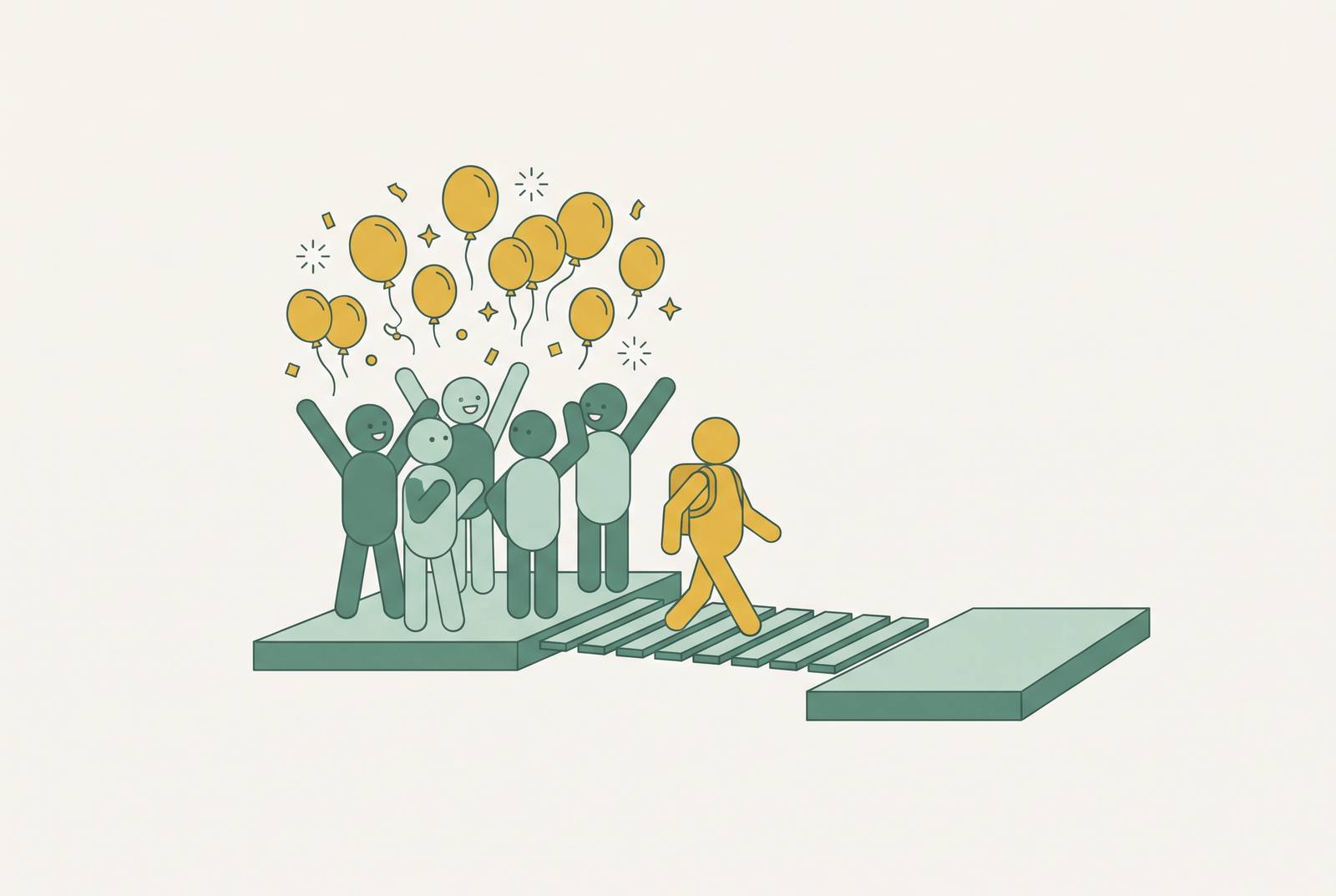
Fixing plans that die in the group chat requires a specific decision, a named owner, and a visible follow-through mechanism. Collective excitement is not the same as collective commitment, because reacting to an idea does not settle who will do what or when. The practical solution is to resolve decisions in sequence, set a decision deadline, and put the agreed date, time, and place on a calendar without making everyone leave the conversation to organize it.
Why group chats feel like a plan forming but rarely produce one
Someone suggests getting together, fire emojis appear, and a few people say “I'm in.” For a moment, the plan seems to exist. Then the thread goes quiet, with no date, time, or place agreed. The disappointment comes partly from how much progress the conversation appeared to make. Everyone could see the enthusiasm, so it seemed reasonable to expect something to follow.
That expectation confuses an emotional state with a behavioral one. Excitement establishes that an idea appeals to people, while commitment establishes what they have agreed to do. A thread can generate the first without producing the second. The missing link is a mechanism, and treating the failure as evidence of unreliable friends obscures the problem that needs solving.
How the group chat's design diffuses the responsibility to decide
A planning message reaches everyone, but it assigns responsibility to no one. Each member can see that others have received the same invitation and can reasonably expect someone else to respond first. That creates a bystander-effect-like pattern in which people wait because they know others have seen the message too. Everyone has access to the next step. No one has been given ownership of it.
Stanford's research on participation commitments looked at the idea that online groups should ask members only to be there. The research found that over 50% of group members were never seen again after their first post. Its explanation centered on membership without obligation, where lurking is expected and members feel little personal responsibility for whether the group survives. This evidence is limited to online groups. Still, it points to a design problem for groups that depend on people choosing to take part.
In a planning chat, that problem appears as waiting for everyone else to establish a direction. A person can want the gathering to happen without believing that choosing the date is their responsibility. Silence can come from people who are still interested. It can mean that the next action has no owner. Public visibility makes the proposal shared, but it does not make the work of deciding shared in any useful sense.
Three structural features of text threads that bury decisions before they form
Even when someone tries to move the plan forward, three features of the thread get in the way and make each other worse. The first is signal-to-noise burial, because logistics occupy the same channel as memes, news, and tangents. A proposed date has no inherent priority over whatever message follows it. Someone returning later must reconstruct the discussion to identify the current decision.
The second obstacle is the open-ended question. “When is everyone free?” sounds considerate, but answering requires each person to scan their availability, decide how much to share, and type a useful response. That is work before any option exists. A reader can defer it without rejecting the plan, especially while expecting others to answer first. The question expresses flexibility at the cost of making the next action harder to complete.
The third obstacle is trying to settle too many things at once. When the date, time, venue, logistics, and costs remain open together, an answer to one question leaves the others unresolved. A venue suggestion does not settle availability, and an available date does not establish agreement about cost. Each reply can advance a different part of the discussion. The conversation can grow without bringing people closer to a decision.
An open-ended question about when to meet is harder to answer when it is buried under replies about venues and transport. By the time someone finds it, the discussion may have moved elsewhere without resolving it. The reader has to find the question and work out whether it still needs an answer. That burden belongs to the format.
Why a chat "yes" is not a commitment — and what actually makes one
A chat “yes” is evidence of agreement, but its meaning depends on what has been proposed. Agreement with the idea of meeting is not agreement to attend at a particular time and place. A low-cost reply supplies neither a named person responsible for following up nor a mechanism that makes abandonment visible. Treating it as a finished commitment asks the message to do work it has not done.
Commitment in this setting requires a specific decision, a named owner, and visible or costly consequences for abandoning the plan. A specific plan gives people something they can say yes or no to. Ownership establishes who will move it toward completion. A follow-through mechanism makes the promise more than an isolated statement in a moving conversation. These conditions require a different structure around enthusiasm.
The Stanford study found that when members had to make commitments others in the group could see, contributions doubled and the large majority stayed active weeks later, compared with a control group that asked nothing of its members. The relevant contrast is between optional presence and an explicit expectation of participation. Peers could see who had promised to contribute.
Successful plans made entirely in chat do not invalidate this distinction. Often, one person adds the missing structure by choosing the date, chasing answers, and taking the risk of seeming pushy. The conversation is still the medium of coordination. The person, however, is providing the decision process and follow-up that the thread does not supply by default. Their contribution can be easy to overlook precisely because the finished plan appears in the same place as the original suggestion.
The intention-behavior gap: why even genuine commitment often doesn't survive
A settled decision solves the first problem, but not the whole problem. Forming a commitment and acting on it later are distinct behavioral events. A person can genuinely intend to attend when they agree, yet fail to follow through when the time comes. The thread's passivity extends beyond the initial decision. Once the excited exchange ends, it does not itself reinforce the promise or address the friction between agreement and action.
Michelle Z Yang and Paschal Sheeran's nationally representative UK survey looked at whether people first committed to organ donor registration and then followed through. Their 2024 study found that even a little friction between those stages led to a large drop in follow-through. It also found that the factors associated with initial commitment differed from those associated with later action. Initial commitment was linked to attitudes, norms, and perceived behavioral control. People were more likely to follow through when they had less anticipated negative affect, more favorable descriptive norms, and stronger identification with organ donors.
The study concerns organ donation. Its relevance is the distinction between predicting a promise and predicting whether that promise survives an obstacle. It does not establish a rate of failure for group-chat plans or prove that the same factors operate identically in friendship groups. It does challenge the assumption that a sincere initial decision is enough. A planning process must account for how agreement is obtained and what happens afterward.
In social planning, the interval between saying yes and showing up leaves room for everyday life to interrupt. A dormant thread offers no active bridge across that interval. The plan can remain nominally agreed while losing its practical place in people's schedules. This is a second failure mode, separate from never reaching a decision at all. Both arise when a conversation records an intention but supplies no structure for advancing it.
How to get a friend group to commit instead of just hyping plans in chat
The practical response is to sequence decisions, name an owner, and introduce a visible deadline or follow-up trigger. Sequencing begins by separating interest in the idea from the work of scheduling it. An initial “yes” remains provisional, but it establishes who wants to work toward a plan. Scheduling then becomes a defined next step. Once that step is resolved, the remaining details can be settled without reopening everything at once.
When a plan has drifted, one person calling the date can end the stalemate created by mutual deference. This is the limited function of benevolent dictatorship. The owner is responsible for bringing the discussion to a decision and following up. That role makes it clear who must act when the conversation stalls.
The message “vote by Friday so I can lock this in” identifies both a requested action and the point at which discussion will become a decision. It gives the owner a reason to follow up. It also lets participants understand what their response will enable, rather than asking them to contribute to an indefinite exchange. The deadline works with ownership, because a cutoff without anyone responsible for acting on it leaves the next step unresolved.
A real calendar invitation then gives the agreed date, time, and location a place outside the flow of messages. That is a different function from another enthusiastic reply. The invitation records what people are being asked to do, while visible commitments show who has promised to take part. Pencil belongs in this discussion as an example of the in-conversation approach to planning. That approach should help people move from interest to a decision and then follow through, beyond just keeping the conversation going.
These mechanisms address different points of failure. Sequencing reduces the burden of deciding, ownership prevents responsibility from dispersing, and a deadline interrupts passive waiting. The calendar invitation supports the transition from an exchange of messages to an actual scheduled event. These steps work without blaming people for being slow to decide. Their purpose is to make the next action clear enough that willing participants can take it.
Why the solution should live inside the conversation, not require leaving it
A commitment mechanism can be well designed and still fail if activating it requires too much effort. Moving a group from a text thread to a separate booking page or planning app adds a step before people can agree. Participation must survive that transition as well.
Human-computer interaction research gives a broader reason to design for the group as a whole. Soohwan Lee, Seoyeong Hwang, Dajung Kim, and Kyungho Lee's study of conversational agents examines how agents can support critical thinking in group decision-making. Lee, Hwang, and Lee's separate Group Experience framework paper argues that AI design has underserved the dynamics that emerge between people. The framework is a theoretical provocation. These works look at how people work together when they use a tool, beyond how easy it makes things for one person.
Helping one person produce a message is not the same as helping a group establish an owner, resolve a decision, and recognize a shared commitment. An in-conversation approach is relevant because the coordination begins between people already speaking to one another. The approach still needs to make it easier for people to reach an agreement and stick to it. Remaining in the conversation is valuable when it preserves access to that shared process.
The warmth of the original exchange is worth preserving. Friends should not need to replace it with a formal process that feels like work merely to settle a gathering. The purpose of structure is to catch that willingness while it is present and give it somewhere concrete to go. When the date is settled and the invitation lands, the pleasure of the idea becomes something people can look forward to together.
Sources
- Commit: Online Groups with Participation Commitments
- Beyond Individual UX: Defining Group Experience(GX) as a New Paradigm for Group-centered AI
- Who follows through? Different factors predict initial commitment vs. Following through in a national survey of organ donor registration
- Conversational Agents as Catalysts for Critical Thinking: Challenging Social Influence in Group Decision-making
- Diffusion of Responsibility - The Decision Lab
- Review Using Group Chats to Drive Behavior Change in Digital
- Feeling connected but dissimilar to one’s future self reduces the intention-behavior gap
- Expressing intentions is not climate action