Move the Plan Out of Chat and Into a Tool That Forces a Decision
A deadline and direct questions inside the thread turn commitment into reality.
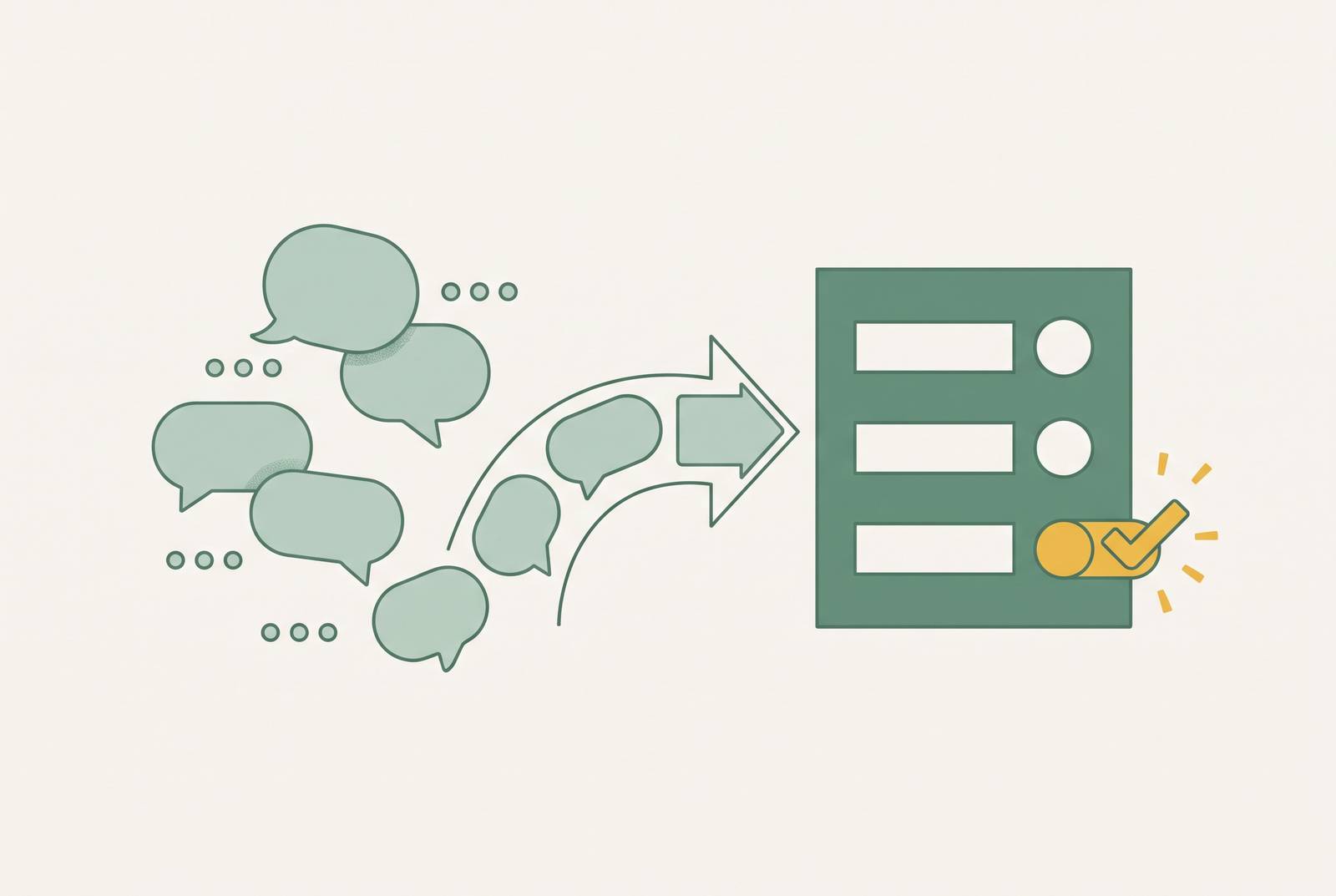
Fixing plans that die in the group chat requires a visible deadline, a real headcount, and individual accountability inside the conversation. Moving the planning to a separate tool often leaves one more request unanswered without getting people to commit. The better approach is to bring decision-forcing structure into the thread, where a specific proposal can become a confirmed plan without asking everyone to go elsewhere.
Why the "move it to a tool" instinct makes sense but backfires
The impulse is familiar after another inconclusive exchange. Someone suggests using a proper tool, and that sounds like a relief. Availability could have a designated home, replies could become legible, and the organizer could stop scrolling through messages to reconstruct the plan. The instinct recognizes a genuine structural failure. A conversation without a deadline, accountability, or a single source of truth gives people no clear way to finish deciding.
Before the group can settle the plan, people must click a link, sign up, or connect a calendar. Instead of waiting for everyone to answer in chat, the organizer waits for everyone to participate somewhere else. The flaw is not the attempt to add structure, but placing that structure outside the conversation where the group already pays attention.
How do plans actually die in the group chat?
A window when someone is free scrolls away under an unrelated message, while reactions and off-topic chat bury the details the group needs to decide. Nothing clearly distinguishes an unresolved question from a completed decision. Urgent requests share space with messages that can wait. This scroll-away problem makes the conversation a poor record of what remains open, even when every participant is acting in good faith.
Diffuse responsibility makes that weak record harder to repair. A question addressed to eight people belongs to everyone and therefore to no one in particular. “What works for everyone?” also sets an optimization problem with no stopping condition, because there is always another schedule to accommodate. Nobody knows when the search is finished. The group can keep talking about availability without anyone having to say yes or no to a specific plan.
Emoji RSVPs add a different kind of uncertainty. A reaction can show that someone likes the idea without saying whether they plan to come, so the organizer has encouragement but still lacks a headcount. The distinction becomes visible when an open question becomes a closed one. “Does Saturday the 9th at 7pm work, yes or no?” asks for a decision instead of asking each recipient to solve the whole scheduling puzzle.
Delay then adds an emotional cost to the structural one. An unanswered message creates pressure, the next notification starts to feel like a task, and participation drops. A thread can go quiet because answering has become awkward even while everyone remains committed to the friendship. Treating this as a personality problem misses how an unbounded request turns ordinary hesitation into collective inaction.
Why moving coordination out of chat doesn't fix these failure modes
A separate scheduling tool can make availability easier to see. That is a useful improvement for the organizer, but availability and commitment are different answers. Knowing when someone is free does not establish that they have agreed to come. If non-commitment is the blocker, a clearer display of possible times leaves the central question unresolved. The plan still needs an explicit decision from the people involved.
The link itself also remains inside the same unreliable thread. It can scroll away just as the original question did, while a request for everyone to complete it still diffuses responsibility across the group. Adding a scheduling interface leaves open whether people who sent an emoji will come. Someone must still distinguish a reaction from an RSVP. Moving the response destination therefore leaves the original failure modes in place unless the process also adds a deadline and direct follow-up.
Each person who does not open the link or complete the required setup becomes another blocker if the plan waits for everyone. Different calendars, apps, and operating systems can complicate that handoff further. The social context also changes. The warmth of a shared suggestion lives in the thread, while the separate interface asks participants to complete a transaction before the conversation can move forward.
If someone will not click a link, perhaps they were never sufficiently committed to attend. That reasoning fits a formal event better than a casual plan whose purpose is the relationship itself. Willingness to use a tool is not a clean measure of genuine interest. Filtering friends by their response to an administrative step can exclude people without resolving whether they wanted to spend time together.
What decision-forcing structure actually requires
A viable plan needs three ingredients, which are a visible deadline, a real headcount, and individual accountability. The deadline sets a time for the discussion to end so the invitation does not stay open forever. It is the most important ingredient because delay drains the motivation that produced the suggestion. A specific date, time, and location turn vague agreement into something people can assess. Until then, apparent consensus may be agreement only with the idea of meeting.
The headcount must identify people who are actually coming. Named commitments change the social calculation for other participants in a way that a collection of reactions cannot. Individual accountability then makes the unanswered portion of the plan explicit by putting the question to each person directly. These ingredients work together. A deadline leaves things unclear if people have not answered directly, while answers can still change as the discussion goes on without a deadline.
“Saturday the 9th at 7pm, yes or no” supplies a decision format that “When’s everyone free?” lacks. A visible response deadline and a location complete the structure around that question. The purpose is to make each person’s next contribution small and definite enough that the group can stop negotiating.
Why iMessage is already the right surface for this structure
For a group already making plans in iMessage, the thread is the primary social environment. It contains the suggestion, the enthusiasm, and the context that gives the invitation its meaning. Keeping the decision there preserves that continuity. Participants can respond where the plan began rather than move into a separate process whose connection to the original exchange must be maintained. This is a case for serving each existing group on the platform where it already gathers.
Apple’s iOS 26 adds polls to iMessage so participants can share opinions and vote on decisions. Apple Intelligence can also suggest creating a poll when it detects planning-related questions. These are genuine improvements to the conversation’s ability to support decisions. A poll spells out the choices and gives everyone the same way to answer. It addresses the ambiguity of scattered replies without sending participants away from the thread.
A vote, however, is not the close of a plan. Someone still needs to establish when responses are due, follow up with people who have not answered, and turn the result into a calendar invitation. Native polls support the decision surface, but not the agent responsible for completing that sequence. An assistant can do the work that the voting feature leaves undone.
What a chat-native scheduling assistant actually does differently
Pencil is an iMessage-native AI scheduling assistant that handles finding a time, following up, and sending the calendar invite without anyone leaving the conversation. Finding a time produces a proposal, follow-up addresses unanswered participation, and the invitation makes the agreed plan concrete. The scheduling work remains attached to the conversation that gave it a purpose.
That continuity gives deadline, headcount, and individual accountability a place to operate together. The group does not have to treat scheduling as a separate project before it can make progress. Follow-up is especially important because a proposal alone cannot resolve diffuse responsibility. An assistant that moves the question forward performs a different role from a passive interface waiting for responses.
Privacy belongs in this design as well. People can share when they are free without showing the calendar details behind those times. For social planning, the group only needs to know whether a proposed time works. Availability-sharing has practical as well as personal value because it limits what the group shares from the underlying calendar to the information required to decide.
An assistant should remember across sessions that Thursdays are off-limits so the group does not have to repeat that constraint every time it talks about meeting. Remembering respects the group’s time. Without that continuity, each new exchange begins by reconstructing information already supplied, making the assistant behave more like a chatbot than an ongoing scheduling agent. Memory is useful here because it reduces repeated explanation.
The distinction from a booking link is therefore behavioral. A link is reactive, waiting for an organizer to share it and for guests to click it. An in-chat assistant is proactive, noticing a plan forming and moving it forward. Pencil illustrates that approach through time-finding, follow-up, and invitation handling. The relevant test is whether those functions close the loop left open by a poll, rather than whether they offer another way to collect the same unresolved preferences.
The real question: what kind of friction is worth keeping
Not all coordination friction deserves to disappear. Discussing a plan can itself be part of the social bond, as people consider one another’s preferences and decide what they want to do together. Efficiency is not the only goal of friendship. The strongest objection to automated coordination is therefore not resistance to software, but concern that the conversation could lose some of its purpose.
That concern requires a distinction between deliberation and ambiguity. Deciding together asks people to engage with one another, while an unanswered scheduling question leaves them unsure what is expected next. These are not equivalent forms of effort. A proposal with clear limits can leave room to talk and still give the discussion an end.
The useful work to remove is the nudging, the re-asking, and the scrolling for a date buried beneath reactions. None of those tasks is a reliable expression of how much the participants value the relationship. The measure of a coordination approach is whether the plan lands on the calendar and whether the people involved still want to make the next one. Follow-through gives the original enthusiasm somewhere to go. Its value lies in the time people finally spend together.
Sources
- The case against efficiency: friction in social media
- Annual Review of Psychology Psychology of Planning
- Framing Matters: Addressing Framing Sensitivity in Decision-Making through Behaviorally-Grounded Value Alignment
- Boosting human decision-making with AI-generated decision aids
- Pre-specified Anxiety Predicts Future Decision-Making Performances Under Different Temporally Constrained Conditions
- Editorial: Decision making and problem solving in organizations: assessing and expanding the Carnegie perspective
- CoS: Towards Optimal Event Scheduling via Chain-of-Scheduling