Handling the Friend Who Never Responds in Group Chats
Silence in group chats is structural, not personal, and fixable.
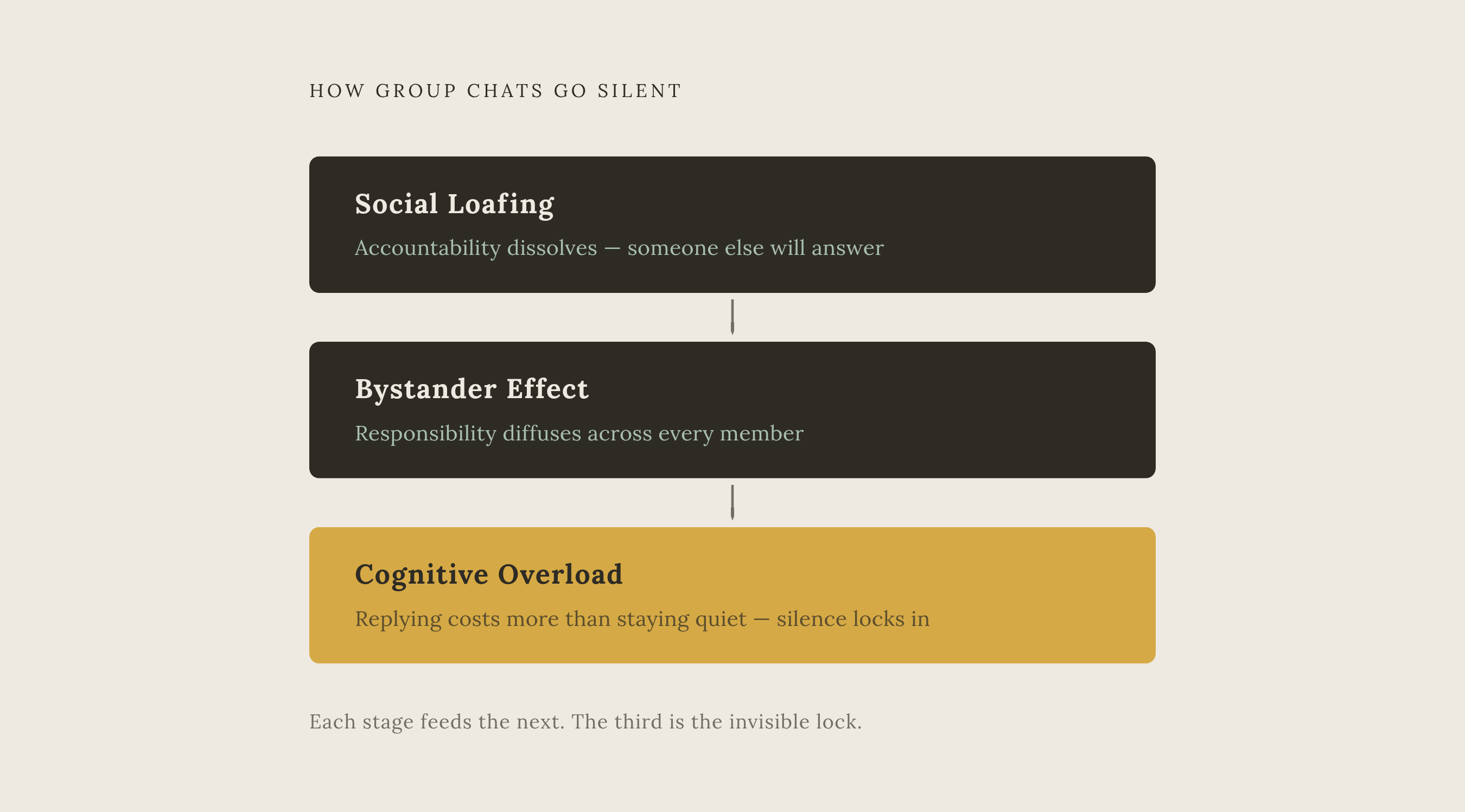
The friend who never responds in the group chat is almost certainly not avoiding you. Three interlocking mechanisms, social loafing, the bystander effect, and cognitive overload, make silence the easiest path for anyone in a group setting. Understanding those forces changes both the diagnosis and the fix.
Why the group chat goes quiet when everyone actually wants to show up
The silence usually gets blamed on the person. The reality is less personal and more structural. When more people are present in a conversation, each individual exerts less effort, a phenomenon social psychology calls social loafing. Personal accountability gets diluted by group membership. Unlike a one-to-one text, where a non-reply is unmistakable, a group chat gives everyone plausible cover. Someone else will answer. The result is collective under-response that no single person intends, and the mechanism operates below the level of conscious choice.
The bystander effect compounds the problem. Research on group coordination, alongside the classic studies in social psychology, shows that the more witnesses present, the less any individual acts. Each silent member assumes someone else will step up, so the responsibility that one person would feel in a private message evaporates across the group. No one is refusing to help. Everyone is waiting for someone else to do it first.
Cognitive overload then tips a hesitant lurker into a permanent one. Group chats do not follow the predictable turn-taking of a one-on-one conversation. Multiple messages arrive simultaneously, and the stream never really pauses. Tech consultant Linda Stone named the resulting state "continuous partial attention," a condition of shallow, always-on vigilance that makes composing a reply feel like more effort than it's worth. The cost of a single message is not the typing. It is the mental work of tracking who said what, what is still undecided, and where the thread stands at the moment one decides to enter it. Faced with that cost, silence becomes the rational default, even for someone who genuinely wants to see their friends.
The lurker is not absent. They are over-present in their own head. The friend who goes quiet is often trapped inside a cycle that has nothing to do with whether they want to attend.
How the group chat format itself manufactures the silence
The silence is partly a product of the medium, not the person. Group chats impose structural penalties that individual conversations do not, and those penalties operate on everyone in the thread, including the people who do eventually respond. Consensus is hard to achieve and gets harder as group size grows. Some members dominate while others barely contribute, an imbalance that quietly shapes who bothers responding at all. The person who consistently jumps in first sets the pace, and the person who tends to read messages late learns that the conversation has usually moved on without them.
Notification overload creates a punishing double-bind. Muting the chat reduces the buzzing, but it also means missing messages directed at the individual. Leaving the chat entirely requires an explicit social act that reads as rejection, and most people would rather endure the noise than perform that exit. The result is a group of members who are all technically present and all partially checked out, connected to a thread that no longer demands their full attention but still carries the weight of their membership.
Three-person groups are socially complex and prone to shifting alliances. Any conversation either involves all three people or creates a two-person exchange that excludes the third. That dynamic produces the particular anxiety of seeing one person respond while another hasn't, a small but tangible signal that the group's attention is not evenly distributed. The silent member in a trio is not absent from a monolithic group. They are the odd one out in a structure that keeps reorganising itself around pairings, and that position is uncomfortable enough to encourage withdrawal.
What the non-responder is actually experiencing
The friend who goes quiet is often doing something active. They are managing their own cognitive bandwidth and the social pressure of immediacy, not passively ignoring anyone. Many silent members prefer to observe rather than actively participate because the chat moves faster than they can keep up with. Lurking is a coping strategy, not a snub. It allows someone to stay current with the group's life without exposing themselves to the demand of producing a response on someone else's timeline.
Past experience shapes current silence. The silence is not laziness. It is a boundary, arrived at through trial and error, maintained because the alternative has burned them before.
Opting out carries relational risk they may not want to trigger. They cannot leave the chat without performing a rejection, and they cannot reply without inviting further demands. Silence becomes the only move that feels like it preserves the friendship, even as it quietly strains it.
The silent friend may not feel unwelcome, but research suggests they may be wrong about how welcome they actually are. The friend who assumes they are unwanted is reading an intentional rejection into what is usually just an oversight, and the quiet consequence is that they stop reaching out. The non-responder needs a corrected mental model as much as the organiser needs a better tool.
Why plans die even after the non-responder finally says yes
Even when everyone eventually responds, the coordination problem does not end. The follow-up gap is where most plans actually collapse. The plan was never rejected. It simply expired while everyone was trying to agree on when it should happen.
Vague and tentative replies, "maybe," "probably," "I'll try," require repeated confirmation that most organisers eventually stop chasing. Each hedge demands a follow-up message, and each follow-up message imposes a cost on the person who has to send it. The organiser becomes the group's unpaid project manager, and the work is tedious enough that most people quietly abandon it.
Even small lapses are enough to derail coordination entirely. The problem is not that friends refuse to commit. It is that the gap between agreement and execution has no owner, and unowned work does not get done.
The relational cost of repeated failure compounds over time. Research published in the Annals of the New York Academy of Sciences in 2025 found that friendships decay quickly without sufficient investment, and a meaningful share of outer-network members can change layer or drop out altogether each year. The non-responding friend is not rejecting the group, but they are at genuine drift risk. Each plan that dies in the thread is a small withdrawal from the shared account, and the balance erodes faster than anyone notices.
Practical ways to actually get a response from the quiet friend
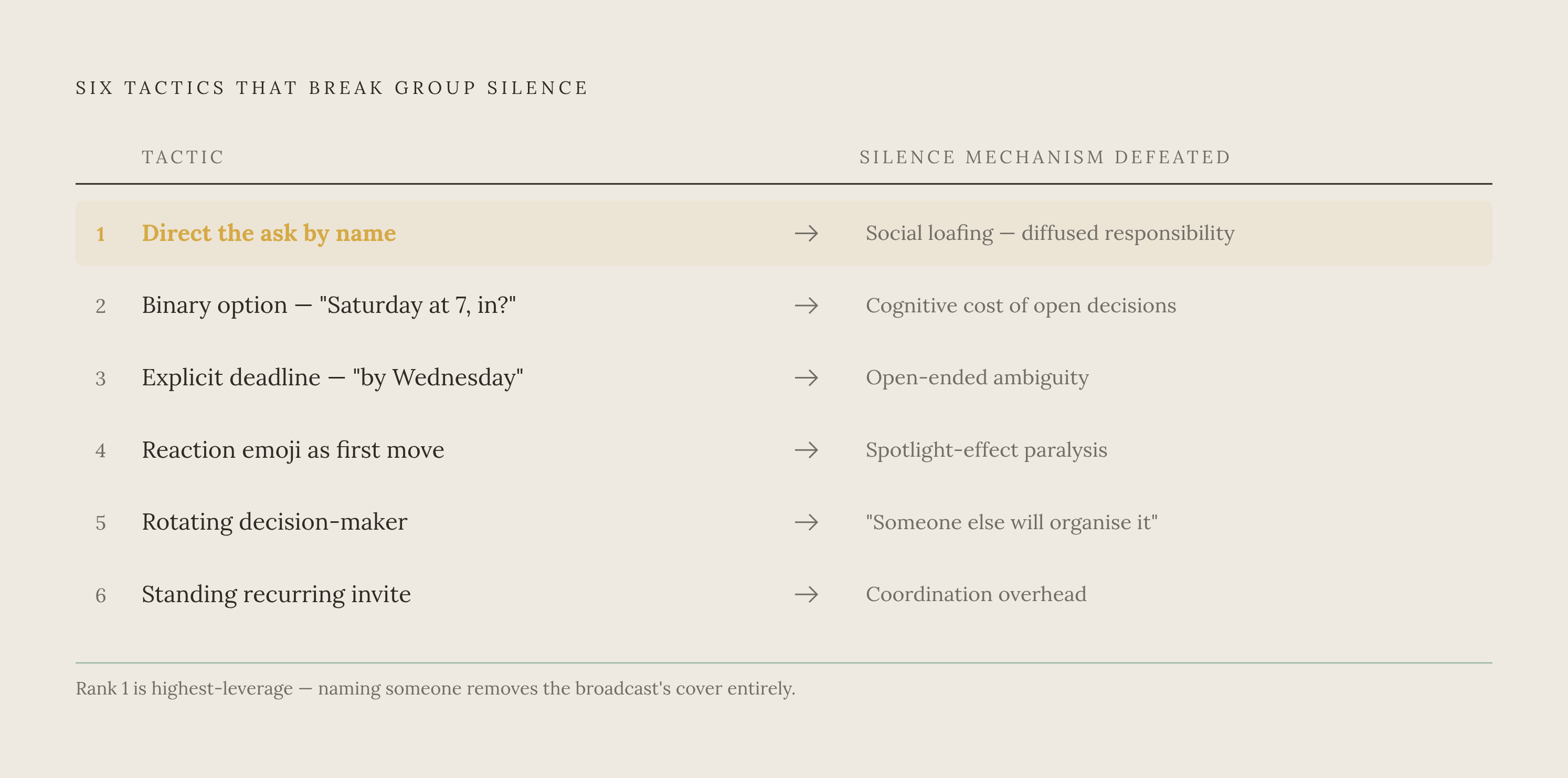
Because silence is structural, the fixes that work are also structural. Small changes to how you ask, who you ask, and when you ask have outsized effect, and each one maps to a specific mechanism that produces silence in the first place. Direct the ask, don't broadcast it. A message addressed to the group is nobody's responsibility. Naming someone specifically re-engages the one-on-one dynamic that produces the highest response rates, because it eliminates the social loafing cover that a broadcast provides. "Priya, does Saturday work for you?" is a different request than "anyone free this weekend?". The former has an owner. The latter has an audience.
Make the ask answerable with a single word. Vague invitations invite vague non-replies. Specific binary options, "Saturday at 7, are you in?", lower the cognitive cost of responding because they remove the work of generating a proposal from scratch. The friend who would never compose a full message can still type "yes."
Set a response deadline explicitly and frame it without blame. A message that says "everyone respond by Wednesday or we'll plan without you" removes the ambiguity that lets silence persist without anyone noticing. It converts an open-ended request into a bounded one, and it does so without accusing anyone of being the problem. The deadline does the work that social pressure cannot.
Give the quiet friend a low-stakes first move. Asking for a reaction emoji rather than a written commitment acknowledges that composing a reply may feel high-stakes and offers a smaller entry point. A thumbs-up is not a full endorsement, but it breaks the silence, and breaking silence is the hardest part for someone trapped in the spotlight effect.
Establish a rotating decision-maker for the group. When one person carries the plan forward each time, the "someone else will organise it" assumption that social loafing produces disappears. Rotation also distributes the work fairly, so no single member becomes the group's default scheduler and quietly resents it.
For recurring plans, remove the coordination overhead entirely. Standing invitations and default recurring events mean the quiet friend never has to respond to a new proposal. They just have to show up, or flag that they cannot. The plan exists independently of the thread, and that independence is what keeps it alive.
How technology can reduce the friction without replacing the social work
The right technology does not solve the social problem, but it removes the logistical overhead that turns a willing friend into an apparently silent one. The interpersonal strategies above change how a group asks. Tools can change what the group has to do at all.
iOS 18 added native message scheduling directly inside the built-in Messages app. No third-party download is required. The feature has a key limitation: it works only within iMessage, not SMS, so Android members of a mixed-platform group are excluded from the workflow. Still, for a group that lives entirely on one platform, the ability to schedule a reminder at a specific time removes the burden of remembering to send one.
Shared calendars and visual availability tools address the "no clear overview" problem. It is impossible to see everyone's availability at a glance when that information is scattered across dozens of messages. A visual layer surfaces consensus that text alone cannot, and it lets the group see immediately whether Saturday at 7 actually works for most people or whether the thread's apparent momentum is an illusion.
The persistent gap in most scheduling tools is that they are built for professional workflows, not for the lightweight, emotionally freighted problem of coordinating dinner with five friends who have asymmetric enthusiasm for making a decision. Friend groups do not work that way. One person cares deeply about the plan, three are mildly interested, and one would rather not think about it until the day arrives.
An AI assistant that lives inside the group chat, rather than requiring everyone to open a separate app, addresses the friction point where most plans die. The moment someone has to leave the conversation to do the scheduling is the moment the plan's momentum breaks. Pencil sits in the thread itself, sees the proposal as it is made, and handles the mechanical work of collecting availability without pulling anyone out of the conversation. The social work, the enthusiasm, the banter, the negotiation, remains with the humans.
Why discretion matters when an AI joins the group chat
Adding an AI to a group chat raises a legitimate question that the technology itself has to answer. Will it share things people didn't intend to share, and will it make the chat feel surveilled? Privacy worries are rising alongside AI adoption, and the American public remains measurably cautious about how AI handles personal data even as adoption accelerates.
The stakes in a social scheduling context are concrete. A 2025-2026 analysis of AI chat and companion app security incidents found that two breaches exposed over 340 million private messages. A group chat about Saturday dinner may feel trivial, but the archive contains years of private life.
Interface design shapes social dynamics as much as data policy does. Research presented at CHI 2026 found that how prominently an AI agent is embedded in a group setting, whether it sits at the table or waits to be invited in, materially changes whether participants feel the conversation is being taken over or supported. A "peripheral mode" design, where the agent must be invited to contribute, preserved group autonomy better than a "Roundtable mode" where the agent could speak at any time. The finding matters: the same assistant can feel like a participant or a tool depending on how it is presented, and the difference is entirely a design choice.
Pencil's approach reflects this. The assistant does not need to know the content of private events to know when people are free, and seeing availability without seeing calendar specifics makes the tradeoff legible. Follow-ups can be disabled in settings, so the assistant's presence is opt-in and adjustable, not persistent in ways that feel intrusive.
The strongest objection: what if better coordination quietly thins out the friendship itself
The most serious objection to AI-assisted social coordination is not about privacy but about texture. Research published in Acta Psychologica in August 2026 found that AI tools strengthen task cohesion, coordination, performance, getting things done, more than social cohesion, and may reduce the discussion and exploration of alternatives that deepens peer connection. In plain terms, the tool that finally gets five friends to commit to Saturday dinner may be quietly eroding the negotiation, the back-and-forth, the small acts of accommodation that are part of what the friendship is.
Task cohesion and social cohesion become structurally decoupled when a tool handles the operational friction. The group gets better at executing plans and worse at the process of making them together. The long thread of half-formed proposals and lazy jokes is not just a coordination problem. It is a place where people learn each other's preferences, where someone discovers that a friend has started a new job or is going through something, where the group's shared life actually happens in the gaps between logistics.
The answer is not to reject the tool but to understand what it is for. Scheduling assistance handles the logistics that currently kill plans before anyone gets to enjoy them. The scheduling assistant is not a substitute for the friendship. It is the mechanism that stops the friendship's machinery from jamming before it starts.
Sources
- Comparing AI chatbots and web-based synchronous collaborative writing tools, leveraging group cohesion, motivation, and performance - ScienceDirect
- "I Felt Bad After We Ignored Her": Understanding How Interface-Driven Social Prominence Shapes Group Discussions with GenAI
- Reading the Social Clock: Analyzing Nonverbal Coordination Dynamics in Casual Chat and Conflict - PMC
- Social presence and dynamics of group communication: An analysis of a health professionals WhatsApp group chats
- Group Chat Ecology in Enterprise Instant Messaging: How Employees Collaborate Through Multi-User Chat Channels on Slack
- Friendship: The Most Overlooked Public Health Asset - Jaimie Arona Krems, Victor A. Kaufman, 2026
- Have a group conversation in Messages on iPhone - Apple Support